Showing posts with label Weather. Show all posts

Saturday, July 14, 2018

Birds and Bugs - Our Adventures on the West Coast on Wednesday, July 11th, 2018

Maggie's Kitchen


This morning we went to breakfast at Maggie’s Kitchen. We met Maggie and her husband, Alan, and enjoyed the hot meal. We also learned that Greymouth, a mining town, had a mining accident where miner's lives were lost. There was a lovely tribute in the cafe for the Pike River Memorial.

The gang with Jo Haley at the Kiwi Creche
After breakfast, we headed to the base of the Paparoa mountains for the Paparoa 
Kiwi Creche. We met Jo Haley, a 63-year-old lady who qualifies as being flexible, 
a good mother, and good in the “bush”. The first thing we noticed was the predator-proof 
fence that costs 300$ per meter. The fence is meant to keep out stoats, mainly, but it  
is possible for baby mice to sneak in. Another measure used to monitor invasive predators 
is through trapping lines and ink cards that capture the footprint of any animal that 
walks over it.

A kiwi feather
An ink card 
A kiwi egg
Jo then told us about Operation Nest Egg which involves raising the kiwis while they are too small to defend themselves. The eggs are collected from the wild and taken to Willowbank for incubation. Once the kiwis are 2 months old, they are moved to the Kiwi Creche for a year before being released into the wild. Kiwis have a 95% chance to survive in the wild after the first 6 months of life and growth.
Jo extracting Juno
We then went out on a kiwi hunt! Jo explained that each of the kiwis in the creche have a transmitter. It was very impressive watching Jo track down 1 of only 3 kiwis in the entire reserve. We met Juno, a 3 month old female (she had a longer beak than a male would). As Jo pulled her from the burrow by her feet, we learned that kiwis use the claws on their feet to fight with. I would have figured that they use their bills to do battle, however, the bill is very delicate. If it breaks, the kiwi will die. Jo also showed us the nostrils under the bill, the whiskers, and the modified feathers.
Jo showing us Juno's wings
Speaking of feathers, kiwis have fragile, small wings that have nearly become vestigial 
through evolution. Since there are no native mammals on New Zealand, kiwis merged into 
that role and are considered “honorary” mammals. Another trait that makes them closer to 
mammals is the fact that they have bone marrow instead of hollow bones, like a regular bird.
Jo showing us Juno's delicate beak
Jo checks the kiwis once a month. This process includes weighing, checking the fat under their ribs, measuring their bill,  and moving the transmitter to the other leg to balance their gait. Juno now weighs enough to be released out into the wild, however, Jo always waits until after Christmas so as not to make the kiwis go through the hardships of winter.
Jo and Juno
We ended our kiwi experience and returned Juno to her burrow.

We spent the afternoon eating lunch at Punakaiki National Park and visiting the Pancake Rocks. The formations were flat stacked limestone rocks formed by thousands of years of erosion. We hurried through the trail as it rained over and over again.
A weka at Punakaiki


 The Pancake Rocks 
Sherman the Sheep enjoying the view
Sherman the Sheep found a natural chair


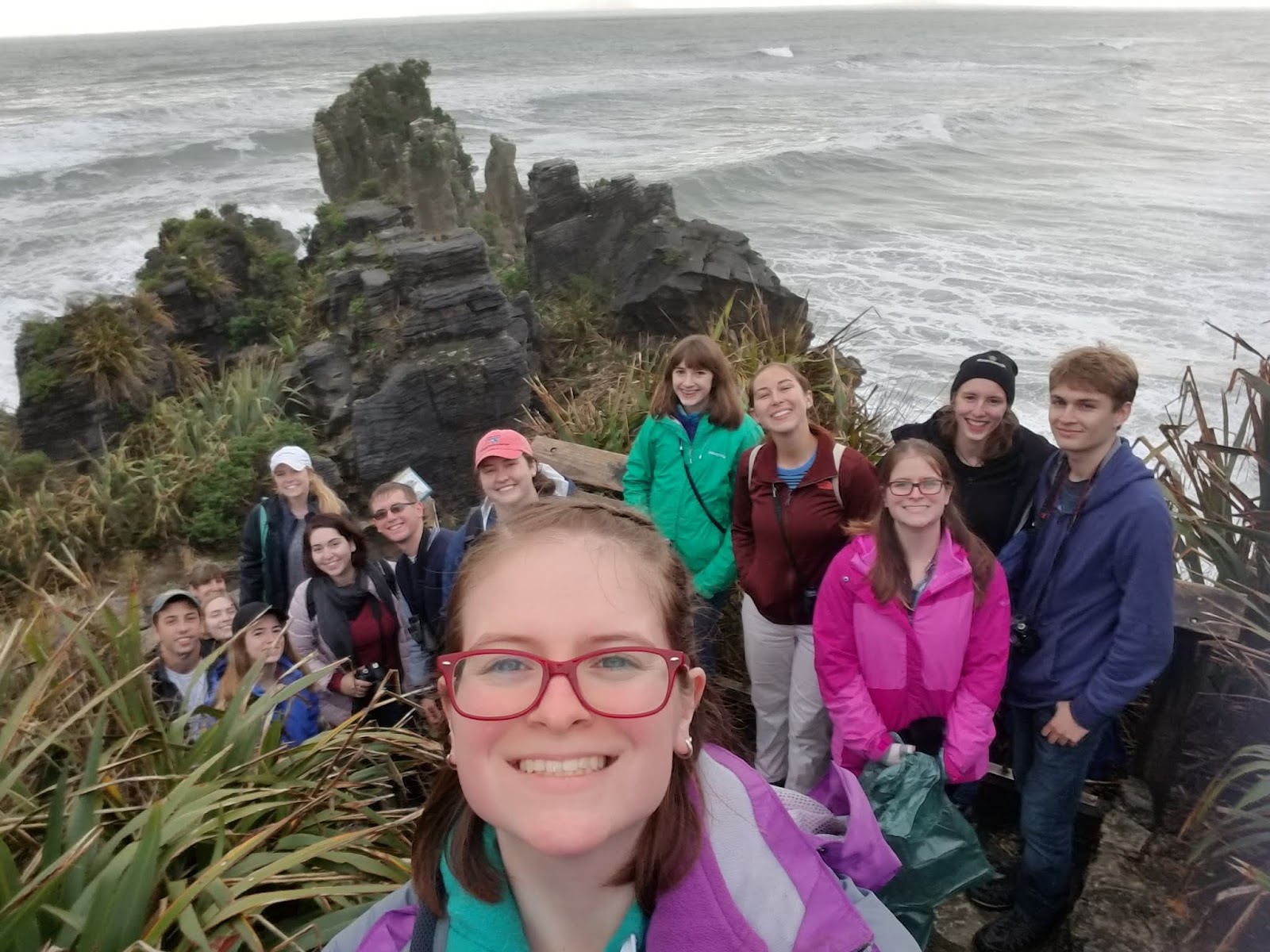
The gang at The Pancake Rocks
We next headed to Fox River to look for the elusive New Zealand Robin. On the way, we saw Nikau palms (the only palm in New Zealand) the Black Tree Fern, (the tallest in New Zealand) the Rata, (the blooms provide food for Tuis) and the Kamahi. Once inside the woods, we shook trees to attract the Robin. All of the raucous simulated when the Moas would walk through and kick up insects for the Robins to eat.
We spotted a koru (Maori for "loop") on this tree fern!


 Don't these look like scenes right out of Jurassic Park?
Paige and Emily jamming


We next met Richard to watch the petrels. They flew overhead from the beach
 and went to the mountains behind us at sunset. It was almost like watching
 the bats come out of the Bat Houses at UF, however, there were 4,000 
breeding pairs of petrels with a wingspan of 1.4 meters. It was quite 
different from a cloud of tiny bats.
Credit to Jámm whose back nearly broke taking these


Our last stop of the day was Punakaiki Cavern. We crouched and crawled 
into the cave with lights pointed at our feet and we turned them off as 
we got nearer so that we didn't disturb the glow worms. They looked like 
twinkling stars in the pitch black cave as they attracted insects for a 
midnight snack. It was stupendous.

I know it doesn't look like much, but this is the ONLY photo we got to capture the glow worms, thanks Caroline!
Finally back in Lincoln,
~Maddie

Thursday, July 12, 2018

Quick Update

Start of the big overnight hike on the Croesus Track
Hi All,

Maddie will still do a post for all of our amazing adventures yesterday tomorrow or Saturday (once we get better internet service), and Jámm will post one about the Croesus Track, but wanted to let you know everyone left for the overnight hike this morning and arrived safely at the top of the mountain before nightfall.  All is well.

Hope the skies clear and you get a beautiful starry view from the top!

Sweet Dreams, Meryl : )

Snow in July and "The Birds" IRL

Today's excursion was actually the start of a 5-day treck to the west side of the south island. We started off the day driving to the mountains. We passed through a town called Springfield, where the main tourist attraction was the Simpson's donut. They used to have a giant tire, but apparently a vandal set it on fire a few years back.
We later got to Porter's Pass, where we encountered snow for the first time in New Zealand. Luckily, visibility on the mountains was very clear; hardly any fog was present blocking the amazing view. 
Enjoying the views, we continued on to Castle Hill, which was full of limestone rock structures. The whole place used to be underwater, and the acoustics were great. The ultimate game of Marco Polo could totally be played there. 

On our way to lunch, we stopped at the Avalanche Creek Shelter. We were told that we may be able to see a Kea, the only alpine parrot in the world. It just so happens that it's also very endangered as well.There was a belief previously that the Kea would prey on sheep, so farmers used to shoot them. Well, it turned out that this bird was not at elusive as it was made out to be, because they tend to like an audience. It also became quite clear that they were used to being fed because one hopped over, jumped up on the picnic table and consequently stole a sandwich. (Photo courtesy of Jámm)

After that eventful lunch, we went to Devil's Punchbowl Track, where we hiked to a nearby waterfall. The weather was still amazing, but the bridges going towards the falls were covered in ice and slippery. On the way up, we were showed the stinkwood plant and black beech, which was pretty cool to learn about. 

We ended the day by watching the sunset at a beach in Greymouth and checking into our hotel. At night, we learned how to weave flax into fish figurines! Everyone added a touch to personality to the school of fish. Can't wait for the next 4 days!

-Emily

Monday, July 9, 2018

Gone With the Wind... Almost.

Our amazing luck with weather has held, today dawned bright and clear as we prepared for another day of lectures and light hiking. Our lectures today consisted of an overview of the invasive animal species in New Zealand and solutions to that problem.
Pablo Garcia Diaz elucidated us on the many difficulties that New Zealand has faced in its quest to reclaim the island from the exotic invasive species that have grown out of control, like brushtail possums, stoats, and the rat. Later, Will Allen explained the different communication techniques that are required to create successful and long-lasting partnerships for sustainability and conservation. He often stressed that the most successful method of improvement for a project or team was constant self-evaluation; you have to understand why something worked or didn't work so that you can continue successes but avoid repeating mistakes.
As a final exercise he had us create rubrics for our course so we may evaluate what we liked/disliked, and what was successful/needs improvement. By the end of the course they'll be filled out with notes on what can be improved, so look out Dr. Hostetler!

As the lecturing half of our day drew to a close, we stopped at Coffee Culture for our morning teatime, then headed to the Ahoriri Scenic Reserve for a light hike to the top of a bluff.
It was a gorgeous hike full of native flora, like five finger (in Maori whauwhaupaku), and tussock grass. While we walked, the bellbirds (korimako) serenaded us and the curious fantails (piwakawaka) swooped in for a closer look. The view from the top of the bluff was well worth the hike, even if the wind threatened to blow us off the edge...
don't worry we were told to not go anywhere near the drop off.
After hiking back down to the Gatorwaka we drove to Governor's Bay to look for a royal spoonbill, rather like our roseate spoonbill, just white. Unfortunately it was still too high a tide to find it wading in the bay, but we enjoyed the view of the tide receding from She Universe, our afternoon tea time spot.
As we left Canterbury behind we caught a white flash in the bay that could have been the spoonbill, but we may never know. - Corinne

Saturday, July 7, 2018

Exploring Banks Peninsula as a Tourist ; )


Map of the Tourist Drive
We woke to a WARM (high of the day was 68 degrees F), clear morning, and readied ourselves for a leisurely day along the Tourist Drive on the crater rim of the Banks Peninsula.  
Group picture with Hugh Wilson and View to Otanerito Bay from Hinewai
After tidying up the Visitor's Center at Hinewai and saying our well wishes to Hugh, we made the steep hike up to the Gatorwaka and got on the road.  Along the summit road, we saw breathtaking views out towards Akaroa and the bays along the road we came in by on Thursday as well as beautiful views of the bays out along the Pacific Ocean side of the Peninsula.  
Checking out the Wakas (boats) at the Maori museum
Our first stop was at Okains Bay, and the Maori and Colonial Museum. Here we saw a significant collection of Maori artifacts from flax woven garments and eel nets to bone fishing hooks, carved boats, greenstone (pounamu or jade) weapons, a marae (sacred meeting house), and more, along with colonial artifacts including turn-of-the-century stove, sewing machine, guns, farming equipment, blacksmith tools, etc.  And, many of our students took delight in the grounds cat, named Suki, that endeared herself to us.

Next up, lunch on the beach - beautiful and sunny with beautiful views of the Pacific.


The hills are alive with the sound of sheep...
Cows hanging out along the Tourist Drive
Views to the Pacific
900 year old Totara
After lunch, we continued along the Tourist Drive, stopping to take pictures of sheep, and cows, and turquoise water and Hobbity-looking hills...  Last stop on the tour, a 900 year old Totara tree!

Trying on sheep fleece-lined hat at the Artist Coop
Of course we also had our 3:oopm tea time and a little time to snoop in the Art Gallery and Artist Coop in Little River before heading back to Lincoln for the night with time to catch up on some laundry before our next adventures tomorrow.

Sweet Dreams All, m&m : )

The Infamous Hinewai Hike

World Famous in New Zealand - Hinewai Reserve and Hugh Wilson
Today was the day to finally take our first serious hike. I'm not going to lie; we were all a little nervous about what a four-hour-long hike would feel like. However, I think we were pleasantly surprised to discover what a marvelous experience it was for us all. Sure, we are quite sore in all sorts of strange places due to climbing steep hillsides and practically sliding down the side of the mountain, but we did make it to the end.
Our first stop of the hike was a gorgeous waterfall. We all excitedly scampered down the steps to get a good photo of the natural landmark. 
The next stop before we truly began hiking was to visit an extremely old Tōtara tree, otherwise known as a male Podocarpus. This ancient being is around 600 years old! It was truly amazing to behold nature's patience in action. 
And of course, like the millenials we are, we had to stop and take a hike selfie.

As we hiked along, we would occasionally stop to admire the native plant life that had returned to Hinewai Reserve. The poro poro tree was one of the first to return after a wildfire erupted on the sanctuary. We also saw multiple kinds of beech trees as well as the cherished silver fern that has become a well-known symbol of New Zealand and its culture. 


But how can we talk about flora without talking about the fauna? As we tramped across the terrain, we would suddenly become silent as a tomtit or a group of silver eyes flitted across the trail ahead. Other birds that we spotted included an exotic blackbird, some chickens, a grey warbler, and brown creepers in the underbrush. 


And how could I make a blog post without somehow referencing New Zealand's resident Hobbits? We approached Lothlórien and soon descended upon an eerie path that looked too much like the place where the ringwraiths first searched for Frodo and his companions. 

After completing the trek, we made some new friends with the help of our human friend, Paul (a helper at Hinewai Reserve). Paul housed many endangered parakeets (red nosed Kakariki) as well as a large, female Akaroa wētā that some of us were brave enough to hold. As we discussed the animals, we had a few curious fantails hopping all around us. With only a lifespan of ~3 years, they sure make the most of it. 

Faintail (Piwakawaka)
Akaroa Weta
We ended our day back at the Visitor's Center where we played card games, watched magic tricks, and puzzled through a couple rounds of Mafia. Even Hugh Wilson, the primary caretaker of Hinewai Reserve, was invited to join us for dinner! At the sprightly age of 73, Hugh elatedly told us the history of the land and how he and two others manage the reserve. I was delighted to meet such an extraordinary naturalist who basically came up with the idea of leaving the exotic gorse on the mountainside. As has been proven, the native New Zealand plants flourish in the shade of the gorse and eventually grow tall enough that they shade the gorse in turn. Hugh is of the mind to let nature take its course (if possible), and his wisdom is currently help restore New Zealand to its original state. 
Back in Lincoln, at last 
~Maddie